Key takeaways:
- A traditional chatbot follows a fixed path of menus, buttons and keywords, and it stalls when the customer goes off script.
- An AI agent understands free text and voice notes, answers from your business information, carries out tasks like bookings and order checks, and hands over to staff when needed.
- The right choice depends on how varied your customers’ questions are, your chat volume, and whether you need tasks done or just routing.
“I have a menu bot on WhatsApp: press 1 for prices, 2 for location. Now everyone talks about AI agents. What’s the difference, and do I need to switch?” The core difference: a traditional chatbot waits for the customer to pick from options you wrote in advance. An AI agent understands the customer’s question in their own words, answers it, and can take a practical step such as booking an appointment.
Not every business needs one. Here’s how to decide.
What is a traditional chatbot?
It’s a rule-based bot: a decision tree of menus and buttons, or replies tied to specific keywords. The customer types “price” and gets a fixed reply, or taps “Book” and the bot asks for a date.
- Strengths: fully predictable, easy to review, and it never goes beyond the text you wrote.
- Weaknesses: it breaks when customers phrase things in ways you didn’t expect, it can’t handle voice notes, and it struggles with two questions in one message.
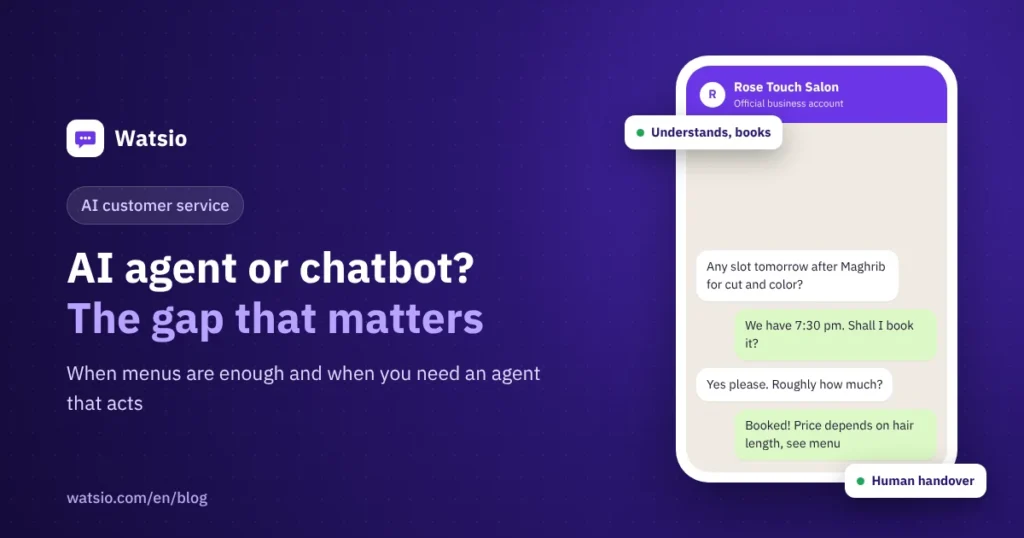
Example: a customer writes, “Do you have a slot tomorrow after Maghrib for a cut and color? Roughly how much?” A menu bot usually sends the main menu again, and the customer gives up.
What does “AI agent” mean?
An AI agent runs on an AI model that understands meaning and conversation context, but it’s limited to your business information and your instructions. What sets it apart from an assistant that only answers questions is that it does things: checks available slots and books, asks for an order number and returns the status, qualifies a property lead and routes it to the right agent.
Meta has embraced the idea too. In June 2026 it announced Meta Business Agent, its AI agent for businesses on WhatsApp, Messenger and Instagram, which answers business questions, recommends products and books appointments. We cover its details and cost in Meta Business Agent on WhatsApp.
How do they differ in customer service?
| Aspect | Traditional chatbot | AI agent |
|---|---|---|
| How it understands | Buttons and keywords | Free text and meaning |
| Dialect and voice | Very limited | Understands dialect; some tools also handle voice notes and reply by voice |
| Doing tasks | Fixed, pre-built steps | Bookings, order checks and lead qualification within your rules |
| Updating | Edit the tree by hand | Update the information and instructions |
| Biggest risk | Customers get stuck and leave | A missing or inaccurate answer if your data is outdated |
| Best for | Few, repetitive questions | Varied questions and high chat volume |
When should you choose each one?
- Pull a sample: take your last 100 WhatsApp chats and sort the questions.
- Check variety: if most revolve around 4 or 5 fixed questions, quick replies or menus are enough for now.
- Check how customers write: if they use dialect, send voice notes and ask several things in one message, an AI agent fits better.
- List the tasks: do you want the bot to book, give order status or collect lead details? The more tasks, the more an agent is worth.
- Measure volume: how many chats a month, and how many after hours? That drives cost and return.
- Start hybrid: a clear welcome message, an AI agent for questions, and a fast handover to staff for sensitive cases.
Roughly what does each option cost?
A traditional chatbot usually comes at a fixed price inside whatever tool you use, and Meta’s normal message fees apply in every case. For an AI agent, it depends on the billing model:
- Meta Business Agent on the WhatsApp platform: billed per token since 1 August 2026, at USD 2.00 per million tokens. A typical reply uses about 20,000 to 25,000 tokens, so about SAR 0.15 to 0.19 per reply. At 1,000 answers a month, token fees alone come to about SAR 150 to 190.
- A platform with AI messages included in the plan: such as Watsio, where assistant messages sit inside the plan price and Meta’s normal message fees stay separate. Service replies inside the 24-hour window have no Meta fee for the first 1,000 per month per number, then about SAR 0.04 each under Meta’s current rate card.
Does WhatsApp allow AI agents?
Yes, as long as the agent is specific to your business. The WhatsApp Business Solution terms banned AI providers whose main function is a general-purpose assistant, like ChatGPT, from the business platform: for new users from 15 October 2025 and for all users from 15 January 2026. An agent that serves your customers in support, bookings and sales is allowed. Details in why ChatGPT left WhatsApp.
How Watsio helps
Watsio’s AI assistant works like an agent inside your business’s limits: it replies in the customer’s Saudi dialect around the clock, understands voice notes and images, replies by text or voice, learns from your website and files, and hands the chat to a staff member when needed. Bookings with deposits and a waitlist are available from the Lite plan at SAR 79 per month before VAT, which includes 2 assistants and 1,000 AI messages a month. Ready to start? Follow our guide to preparing your AI assistant before launch, and salons can see Watsio for salons.
Related reading: AI auto-replies on WhatsApp and the shared WhatsApp team inbox. You can also see Watsio plans and pricing and try it free for 14 days, no card needed.
Frequently asked questions
Does an AI agent replace customer-service staff?
No. The agent handles repetitive questions and simple tasks like bookings and order checks, while staff handle complaints, negotiation and cases that need a decision. Define when the agent should hand the chat to a person.
Are menu chatbots finished?
No. They still suit businesses with few, fixed questions, or as a quick start. But if your customers write in dialect, send voice notes and ask varied questions, menus alone will frustrate them.
What’s the difference between Meta AI and an AI agent for my business?
Meta AI is a general assistant inside WhatsApp that answers users’ general questions, and it doesn’t know your prices or bookings. Your business’s AI agent answers your customers from your own information and within your instructions.
How do I stop an AI agent from making things up?
Connect it to clear, up-to-date information, give it explicit instructions to say it doesn’t know and hand over to staff when it can’t find the answer, and test it with hard questions before launch.
Can I combine buttons with an AI agent?
Yes. You can start with a welcome message that offers clear options, then let the AI agent handle any free-form question, with a fast handover to staff for sensitive cases.
Sources
- WhatsApp Business Solution Terms
- WhatsApp Business: Introducing Meta Business Agent
- Meta for Developers: Pricing on the WhatsApp Business Platform
Last updated: November 2026 · Watsio team.